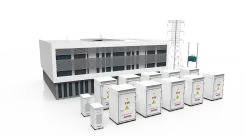
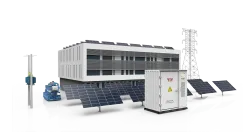
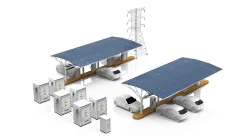
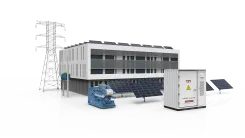
The Grid Stability Challenge in 2026
Modern power grids face unprecedented challenges from the energy transition:
The Renewable Generation Problem
- Solar peaks at noon: When solar generates the most power, demand is relatively low (except on hot summer days)
- Wind is unpredictable: Can vary 50%+ in a single hour, making load following extremely difficult
- Evening demand surge: When solar disappears at sunset, demand peaks just as the sun sets
- Curtailment crisis: In 2025, California and Texas curtailed (wasted) over 15 TWh of solar generation because the grid couldn't absorb it
The Traditional Solution: Fossil Fuel Peakers
For decades, utilities relied on natural gas "peaker" plants to meet evening demand surges—expensive, polluting plants that might run just a few hundred hours per year. Each megawatt of peaker capacity costs $500,000-1,000,000 to build and runs at 30-50% capacity factor.
The Better Solution: Battery Storage
Battery storage provides the same peak-shaving capability at a fraction of the cost, with better performance:
- Response time: 100 milliseconds vs. 10 minutes for gas turbines
- Efficiency: 95% vs. 35-45% for gas peakers
- Flexibility: Can provide multiple services simultaneously
- Cost: $200-300/kWh installed, falling 10-15% annually
The Economics of Grid-Scale Storage
Levelized Cost Comparison (2026)
| Technology |
$/kW-Year |
Capacity Factor |
$/kWh Stored |
| Battery (4-hr) |
$80-120 |
Variable |
$0.15-0.20 |
| Battery (8-hr) |
$60-100 |
Variable |
$0.08-0.12 |
| Gas Peaker |
$150-250 |
30-50% |
$0.25-0.40 |
| Gas CCGT |
$100-150 |
60-80% |
$0.10-0.15 |
Revenue Stacking: How Batteries Make Money
Grid-scale batteries don't rely on a single revenue stream. Instead, they "stack" multiple revenue sources:
1. Energy Arbitrage ($20-50/kWh/year)
Buy cheap electricity during off-peak hours (often negative pricing when renewables exceed demand) and sell during peak hours. Typical spread: $0.05-0.15/kWh.
2. Frequency Regulation ($50-100/kW/year)
Provide rapid power injection/absorption to maintain grid frequency at exactly 60 Hz (or 50 Hz in Europe). Batteries can respond in milliseconds—100x faster than gas turbines. Revenue depends on performance capacity offered.
3. Capacity Payments ($30-60/kW/year)
Commit to being available during peak demand periods in exchange for a fixed capacity payment. Utilities value this reliability.
4. Renewable Integration ($20-40/kWh/year)
Absorb excess renewable generation that would otherwise be curtailed, then discharge when needed. Often paired with power purchase agreements (PPAs) from solar/wind developers.
5. Transmission/ Distribution Deferral ($50-100/kW/year)
Delay or avoid expensive grid infrastructure upgrades by installing local battery storage instead. Utilities save millions in avoided capital costs.
Total Revenue per MWh-year: $150,000-250,000/MW-year
Case Studies: World's Largest Grid Storage Projects
Hornsdale Power Reserve, South Australia
- Capacity: 150 MWh / 194 MW
- Commissioned: December 2017 (expanded 2020)
- Operator: Tesla / Neoen
- Performance:
- Responded to 230+ grid events in first year
- Reduced frequency control costs by 75%
- Achieved full investment payback in under 5 years
- Saved consumers $150M AUD in first 2 years
Moss Landing, California
- Capacity: 3,000 MWh / 1,200 MW (world's largest)
- Commissioned: 2023-2024
- Operator: Vistra Energy
- Purpose: Grid stability, renewable integration, peak demand
Gateway Energy Storage, California
- Capacity: 250 MWh / 230 MW
- Commissioned: 2023
- Operator: TerraGen / LS Power
- Notable: First project to participate in all CAISO market services
Battery Technology for Grid Applications
4-Hour vs. 8-Hour Storage
4-Hour Battery Systems:
- LiFePO4 or NMC chemistry
- Optimized for frequency regulation and peak shaving
- Lower capital cost: $200-250/kWh
- Best fit: Markets with daily price volatility
8-Hour and Long-Duration Storage:
- LiFePO4, flow batteries, or compressed air
- Essential for multi-day renewable integration
- Higher capital cost: $300-500/kWh
- Best fit: High renewable penetration grids (50%+)
Flow Batteries: The Long-Duration Contender
Vanadium redox flow batteries (VRFBs) are gaining traction for long-duration grid storage:
Advantages:
- 20+ year lifespan with no degradation
- Non-flammable, safe for any location
- Capacity scales independently of power rating
- 8-12 hour discharge duration
Disadvantages:
- Lower efficiency (65-75% round-trip)
- Higher capital cost ($350-500/kWh)
- Larger footprint than lithium-ion
Notable projects: Sumitomo Electric (Japan), Rongke Power (China), Redflow (Australia)
The Future: 100% Renewable Grids
California's Path to 100% Clean Energy
California's grid, with 15+ GW of battery storage planned by 2030, is pioneering the path to 100% renewable electricity:
2026 Status:
- Solar: 25 GW installed
- Wind: 6 GW installed
- Battery storage: 10 GW installed
- Renewable penetration: 45-60% (hourly average)
2030 Target:
- Solar: 40 GW
- Wind: 15 GW
- Battery storage: 52 GW
- Renewable penetration: 90%+
The Storage Gap:
Meeting the 100% clean energy target requires:
- 8+ hours of battery storage duration for multi-day weather events
- 100+ GW of storage capacity
- Estimated cost: $50-100 billion
Texas: A Different Model
Texas took a market-driven approach to grid storage:
- Minimal state mandates
- Merchant storage projects (no long-term contracts)
- ERCOT market prices drive profitability
- Results: 5+ GW of battery storage added in 3 years
Conclusion
Grid-scale energy storage has moved from experimental to essential in just a decade. The technology that started as a niche solution for frequency regulation has become the backbone of renewable energy integration worldwide. With costs continuing to fall and battery duration extending, the dream of 100% renewable grids is no longer a fantasy—it's a near-term engineering and economic challenge that will be solved within the next 10-15 years.